9 minutes
2004
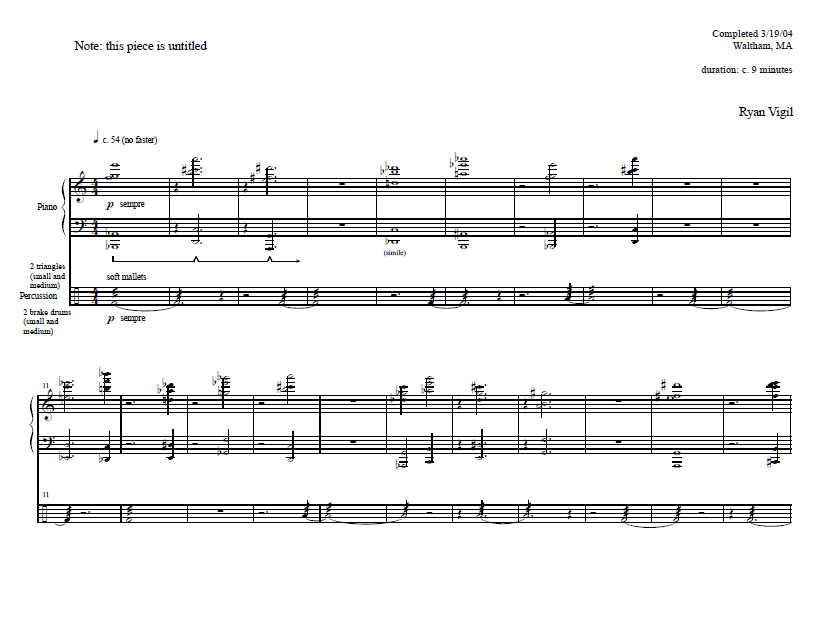
Here is a very simple and relaxed piece of music. Although the two parts are meticulously coordinated, the piano and the percussion, in effect, take no notice of each other. To be sure, they peacefully coexist. But, they do not react to or accommodate one another in any meaningful way. Though entirely continuous, the piano part can be seen to divide into three sections: the first employs “block” harmonies; the second explores bass dyads and triplet rhythms; the third returns to the character of the first, but continues a process of “densification” whereby the harmonies are now clusters, gradually “thinning” by the end. The percussion part is in two sections, the second of which is announced by the first “stick” sounds (playing the brake drums with the handle rather than the head of the mallets). The introduction of two triangles is a standard ending technique—that is, the ending is announced by the arrival of a sonority heretofore withheld from this very spare sound world.
The percussionist with whom I gave the first performance of this piece described it as “elegant,” which remains one of the nicest adjectives anyone has ever applied to one of my compositions.
 RYAN VIGIL