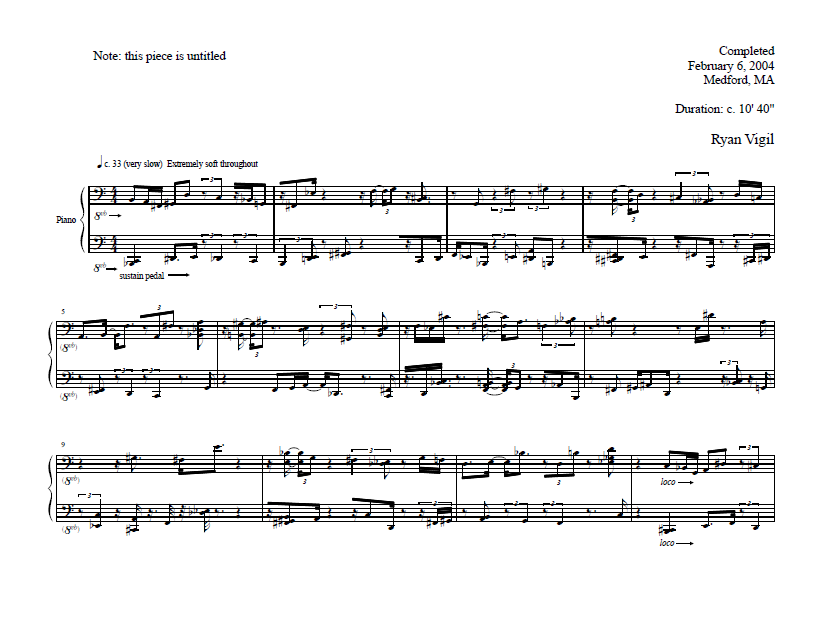
When one has been creating works over a sufficient span of years, it becomes possible to identify certain pieces as particularly significant. If not exactly a turning point, then, at least, a kind of point of arrival from which it is possible to survey the ground covered and the way ahead. For me, this would be one of those works.
About the titling—or lack thereof—elsewhere I’ve had the occasion to write the following:
In the visual arts, as is well known, it is perfectly common to leave a painting untitled. But this practice is essentially unknown in music. Why is it so uncommon to leave a piece of music untitled? It may be related to the nature of music, and the nature of the musical experience. A painting, after all, is a thing. It’s very tangible, and we connect with it through our visual sense, which is perhaps the most central of the five physical senses. Music, by contrast, is unseen and ephemeral. Where is a piece of music? Is the music located in the notated score? What of unwritten music? If a piece of music is simply a collection of sounds, what happens to that piece of music as soon as the performance is over? It’s gone—it vanishes into the ether. This slippery, elusive aspect of music has, I think, at least something to do with the rarity of untitled compositions. The title is something that grounds the piece, locates it, however minimally, in a way that we can grasp and hang on to. In a basic sense, attaching a title to a piece of music (even if it’s entirely practical, and not poetic in any way—a title like Symphony in C, or Composition no. 1) accomplishes at least two things: first, it’s a basic concession to convention; but second, it’s a kind of desperate attempt to prevent the piece from simply floating away.
Looking at my own output, I recognized how often the titles of my compositions were simple and descriptive—Music for Solo Guitar, Three, Violin and Piano. These titles didn’t really mean anything. And, more importantly, my conception of music was steadily moving away from traditional narrative, rhetorical, functional, even structural frameworks, towards a radical foregrounding of purely sonic considerations—an approach I perceived, in different ways, in the music of composers like Varèse, Xenakis, Cage, and Feldman. I found that I wished to provide a musical experience that was as “purely musical” as possible—one that was not really “about” anything, but was simply an opportunity to engage with sound in the most basic and least encumbered way possible. I found myself composing with a sense of “musical abstraction.” And I felt that, for compositions that emerged out of this ethos, the convention of providing a title was basically incongruent. Again, elsewhere I’ve written:
When listening to abstract music you are allowed to focus purely, and solely, on the sound that is happening in the present moment, and thus experience it more fully than might otherwise be the case. The act of leaving the composition untitled is a small gesture, but a significant one, and it’s a statement: these sounds are not connected to anything outside themselves. I don’t want to associate them with any extra-musical ideas whatsoever, not a word, not an image—nothing.
Given this stance, it would be reasonable to question the utility of saying anything about this music. It is, after all, perfectly capable of “speaking for itself.” Indeed, for some time, I felt most comfortable not talking about this music. However, reflecting a pragmatism that is borne of experience, I have no objection to talking about this kind of music. In this case, how about a story about the genesis of this particular piece?
I was at the time living alone in a studio apartment. It was an ascetic lifestyle, full of work, books, music, study, and very little else. I had one phone, a landline, and one day it stopped working. I contacted the phone company from a payphone down the street (remember landlines and payphones?), and we arranged a day for them to come and rectify the situation. I was instructed to remain at home between 8am to 4pm in order to be able to receive the repairman. This seemed an extraordinary request, but there was no flexibility in the matter. I waited at home on the appointed day; no one came. I walked to the payphone, called the phone company, and explained the situation. “Oh yes, sorry about that. We’ll arrange for someone to come out as soon as possible.” I explained that the next time I was available was exactly a week hence, and the date was set. Another Saturday came and went with no visit from the repairman. Another trip to the payphone, and a nearly identical conversation.
The following Saturday, as I waited for the repairman to arrive, I began working on this composition for solo piano. It came as no surprise to me when, for a third time, the phone company failed to follow through on its promise to get a repairman to me within the allotted time. I walked to the payphone and called the company, explained the situation with its full backstory, and calmly asked that my number be discontinued, my account closed, and that I receive reimbursement for the weeks I’d been without a telephone. None of this met the least resistance. And, most spectacularly, I found the next several months of my life—phone-free—to be remarkably peaceful and productive.
So, this piece was written in an environment of patient waiting. And, as I recall, the piece grew out of the simple act of listening to the initial sonorities and responding to “where the sound seemed to be going” (in this case, up).
And so here is the first of what would be a great many untitled compositions. Indeed, although since then it has occasionally been right to give a title to one of my compositions—if a title suggests itself, who am I to resist it?—the vast majority of my compositions have gone without titles (and, I hasten to add, suffered no harm as a consequence).
 RYAN VIGIL