flute, clarinet, bassoon, horn, trumpet, trombone, vibraphone, piano, harp, violin, viola, cello, and double bass
45 minutes
2003
Prior to conceiving of Collection, 2003, I noticed that visual artists could create works, even “finished” pieces, at different levels of construction, while composers always have to produce polished gems. Morton Feldman was getting at something similar when he wrote about how composers always have to “say their own lines.” This is something of an indignity—it’s embarrassing. Here, I wished to open up the “artist’s studio,” as it were, and share the stages of a composition.
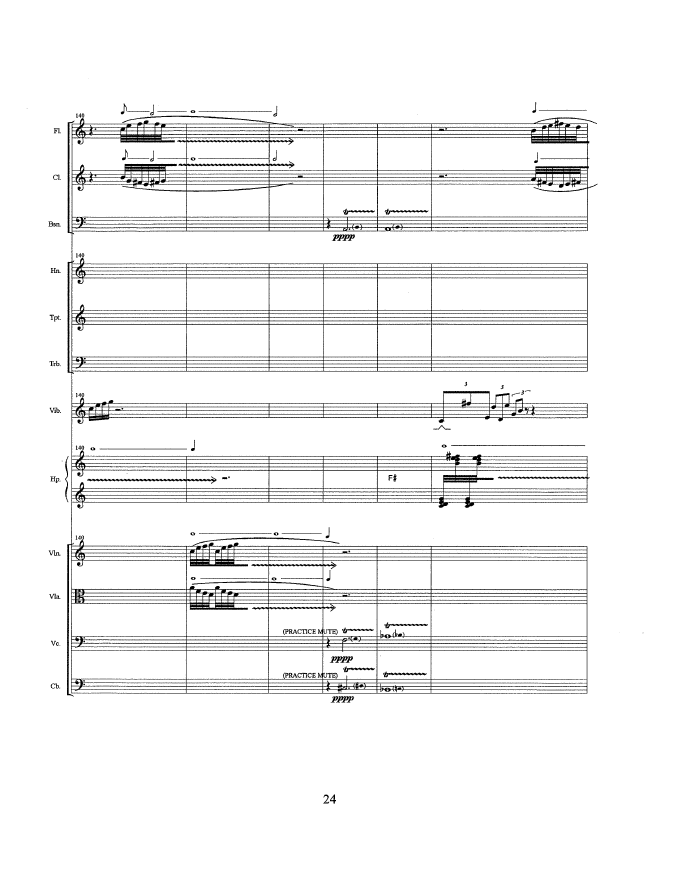
The full work comprises the following pieces (and thus traverses the following stages): two “sketches” for solo piano, and one for violin, viola, and cello (in which basic materials are proposed and explored in a limited way); a “study” for flute, viola, and harp (in which new ideas are introduced and essential elements from the sketches are carefully combined in order to produce a movement of significant proportions); a second “study,” this time for solo harp (in which ideas proposed for piano are “worked out” on the harp); a “construction” for clarinet, bassoon, French horn, trumpet, violin, and cello (essentially establishing a certain kind of dense contrapuntal writing as “structurally sound”); and, finally, a “composition,” for chamber orchestra, in which the preceding elements are brought together and allowed their “full flowering”).
From the point of view of process, working this way was remarkably unselfconscious and “out in the open”—liberating, even exhilarating. Whether or not the final product—both the “composition” that was the culmination, as well as the full Collection (altogether, a kind of “open studio”-experience)—was uniquely self-reflexive, offering interesting opportunities for layered meanings and the construction of a deeply engaging listening experience (that is, whether or not this whole exercise was “successful”), I was never compelled to do anything quite like this again. What may have been the outcome, however, was a stronger conviction that it’s alright for a composition to show its work—that is, not to be afraid of revealing itself—indeed, a recognition of the potential beauty in that kind of vulnerability.
 RYAN VIGIL